Combat-themed slots are common enough that the theme alone signals very little. What matters is whether the mechanics match the framing – and with Fist of Destruction, Hacksaw Gaming has built a system where the fight imagery and the feature logic genuinely align. Released in February 2024, the game runs on a 5×4 grid with 14 paylines and three interconnected features: Expanding Fist Wilds, a Victory Points accumulator, and Epic Drop Respins. The base RTP sits at 96.30%, with a max win ceiling of 10,000x.
This is not a general overview. It is a breakdown of how the mechanic stack in Fist of Destruction by Hacksaw functions – what each system does independently, and why the combination produces a medium-high volatility profile that plays differently from a standard free spins trigger. UK players evaluating this title through licensed operators will find the specifics here more useful than a surface verdict.

How Fist of Destruction Reframes Slot Progression
Standard slot progression follows a fixed shape: spin, land a scatter, enter a bonus, collect a total. The spins between bonuses are structurally neutral – they neither build toward nor prepare for the bonus in any mechanically meaningful way. Fist of Destruction disrupts that model. The Victory Points accumulator means every base game spin contributes to a running state, rather than being evaluated purely on its own win or loss merit.
This is a design pattern borrowed from combat video games – a stagger meter, an energy gauge, a charge bar. The slot equivalent is a meter that builds through qualifying activity and shifts the game into higher-value states when it crosses thresholds. Hacksaw Gaming's implementation ties the accumulator to both the wild behaviour and the respin trigger. That interdependence is what separates a genuine mechanic stack from a list of features that happen to share a title.
Victory Points: The Accumulator at the Centre of the System
The Victory Points mechanic is the structural spine of Fist of Destruction. Points build through gameplay activity on the 5×4 grid and, as they accumulate, move the session closer to the higher-value states the game is built around. What makes this mechanic worth studying is that it changes the player's relationship to base game spins. Rather than treating non-bonus spins as dead time, the system makes them functionally active.

The fighter selection component visible in the game is part of this progression framing. Instead of a standard entry into the bonus round, the game uses a combat metaphor throughout – the fighter, the accumulated points, the fist. From a mechanic design perspective, this gives the accumulator a visual anchor that a standard percentage meter rarely has. The fiction and the function reinforce each other rather than operating in separate layers.
Where the implementation becomes particularly interesting is in how Victory Points interact with the other two features. The Expanding Fist Wilds and Epic Drop Respins are not independent switches – they operate within a system where accumulated progress shapes the conditions under which they fire.
Expanding Fist Wilds on the 5×4 Grid
On a three-row grid, an expanding wild covers at most three positions on a single reel. On a 5×4 layout, the same mechanic covers four positions – a 33% increase in per-reel coverage. That is not a trivial distinction, particularly on a 14-payline structure where adjacent reel coverage drives the most valuable combinations.
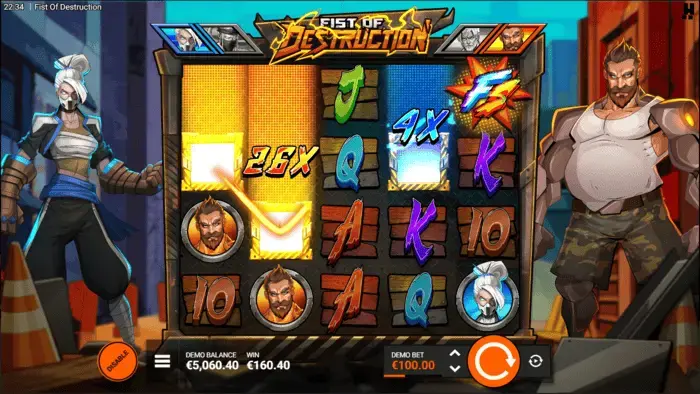
The Expanding Fist Wilds in Fist of Destruction lock a reel completely when active. Two or three of these landing on adjacent reels creates a scenario where a large proportion of all 14 paylines carry wild symbols simultaneously. The combat framing gives this visual logic – a fist impact expanding down a reel reads as a physical event, not an abstract symbol substitution.
Fourteen paylines is a relatively contained structure for a 5×4 grid; comparable grids often use 20, 40, or all-ways configurations. The tighter payline count means expanded wilds have concentrated impact rather than spreading wins across a higher volume of smaller lines. For the mechanic to produce maximum effect, positioning matters more than on a wider all-ways layout.
Fighter Selection and the Throwdown Bonus
The Throwdown Bonus is the primary bonus state in Fist of Destruction, entered through the fighter selection screen. The selection mechanic introduces a decision point before the bonus begins – a structure that sets this game apart from titles where the bonus simply starts after scatter placement. Whether the selection carries distinct mathematical variance between options or functions as a presentation layer depends on the operator's configuration, but it establishes a specific tone for what follows.

The combat theme reaches its most coherent point here. The player selects, the bonus begins, and the Expanding Fist Wilds and Victory Points systems continue operating within the elevated context. This is how well-constructed bonus rounds function in medium-high volatility titles – not a reset of the game's mechanics, but an escalation of them into a higher-stakes environment where the accumulated base game activity pays off.
Epic Drop Respins and Their Role in the Payout Structure
Respins in slots broadly fall into two types: those that hold fixed positions and respin the remainder (hold-and-win format), and those that replay the grid under modified conditions. Epic Drop Respins in Fist of Destruction operate within the second category. They are tied to the accumulated state of the Victory Points system, which means the conditions under which they trigger are shaped by base game activity rather than being a random event layered on top.

The 10,000x maximum win is the ceiling of what this respin mechanic can produce under optimal conditions. Reaching that ceiling requires a confluence of favourable states – accumulated Victory Points, Expanding Wilds in useful grid positions, and the respin sequence delivering above-average results. That is a narrow scenario, which is exactly what a 4/5 volatility rating reflects. The max win is a structural parameter, not a session expectation.
For UK players managing bankroll through Trustly or PayPal at UKGC-licensed casinos, understanding the session shape of an accumulator-style game is practical information. BeGambleAware's guidance on session budgeting applies directly to mechanics like these – the build-up structure can encourage extended play that warrants deliberate stake and time limits before the session starts.
Fist of Destruction RTP Variants and Volatility Profile
The RTP structure in Fist of Destruction is layered across four operator-configurable variants. The difference between the player-favourable rate and the lowest available variant is substantial – not cosmetic. Across volume play, that gap has real consequences for theoretical return.
| RTP Variant | House Edge | Configuration |
|---|---|---|
| 96.30% | 3.70% | Base / player-favourable |
| 94.30% | 5.70% | Operator-configured |
| 92.38% | 7.62% | Operator-configured |
| 88.27% | 11.73% | Operator-configured |
UKGC-licensed operators are required to display the configured RTP variant for each game, meaning UK players can verify which rate applies before playing. With a game built around an accumulator mechanic that builds sessions toward high-stakes states, knowing the underlying math rate at your specific casino is a practical input – one that affects how you think about the risk-to-return profile of each spin, not just the bonus.
The medium-high volatility classification at a $0.10–$100 stake range means the game scales considerably across bet levels. At minimum stake, the 10,000x cap represents $1,000. At maximum stake, it represents $1,000,000. The mechanic operates identically in both scenarios – the risk profile does not.
How the Mechanic Stack Shapes the Session Experience
The interaction between Victory Points, Expanding Fist Wilds, and Epic Drop Respins produces variance in a specific way. Rather than spikes generated by random overlay mechanics, the game's high-value outcomes build through sequential state changes – points accumulate, wilds expand, respins fire under elevated conditions. That sequence takes time, which explains the 4/5 volatility rating on what is, structurally, a mid-size grid with a contained payline count.
For players who find standard bonus-hunt formats repetitive, the accumulator structure in Fist of Destruction offers a different session shape. The base game is not passive. Continuing to spin is not purely about waiting for a trigger – it is about watching a system build toward a state. Whether that engagement model suits a given player's preferences is a genuine question, not a quality judgement on the game.
Hacksaw Gaming's output through 2024 consistently favours feature interdependence over feature stacking. Fist of Destruction is one of the clearer expressions of that approach – a title where the combat theme and the mechanic logic operate as a single system rather than a visual skin over a generic engine.